
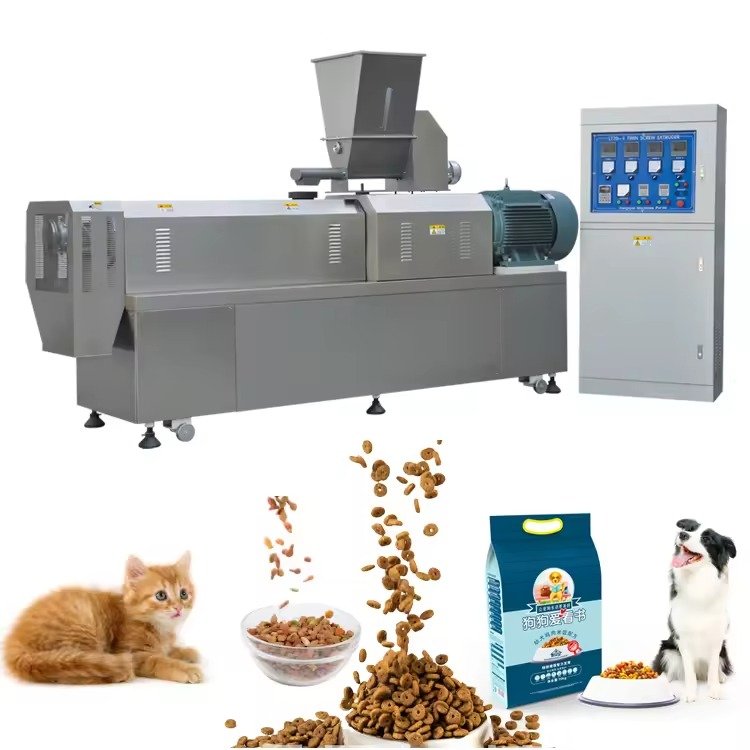
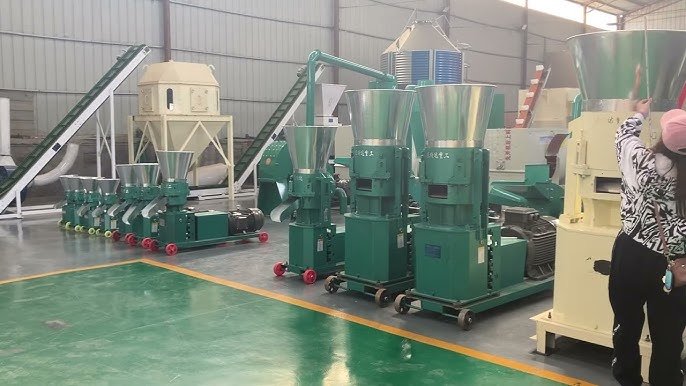
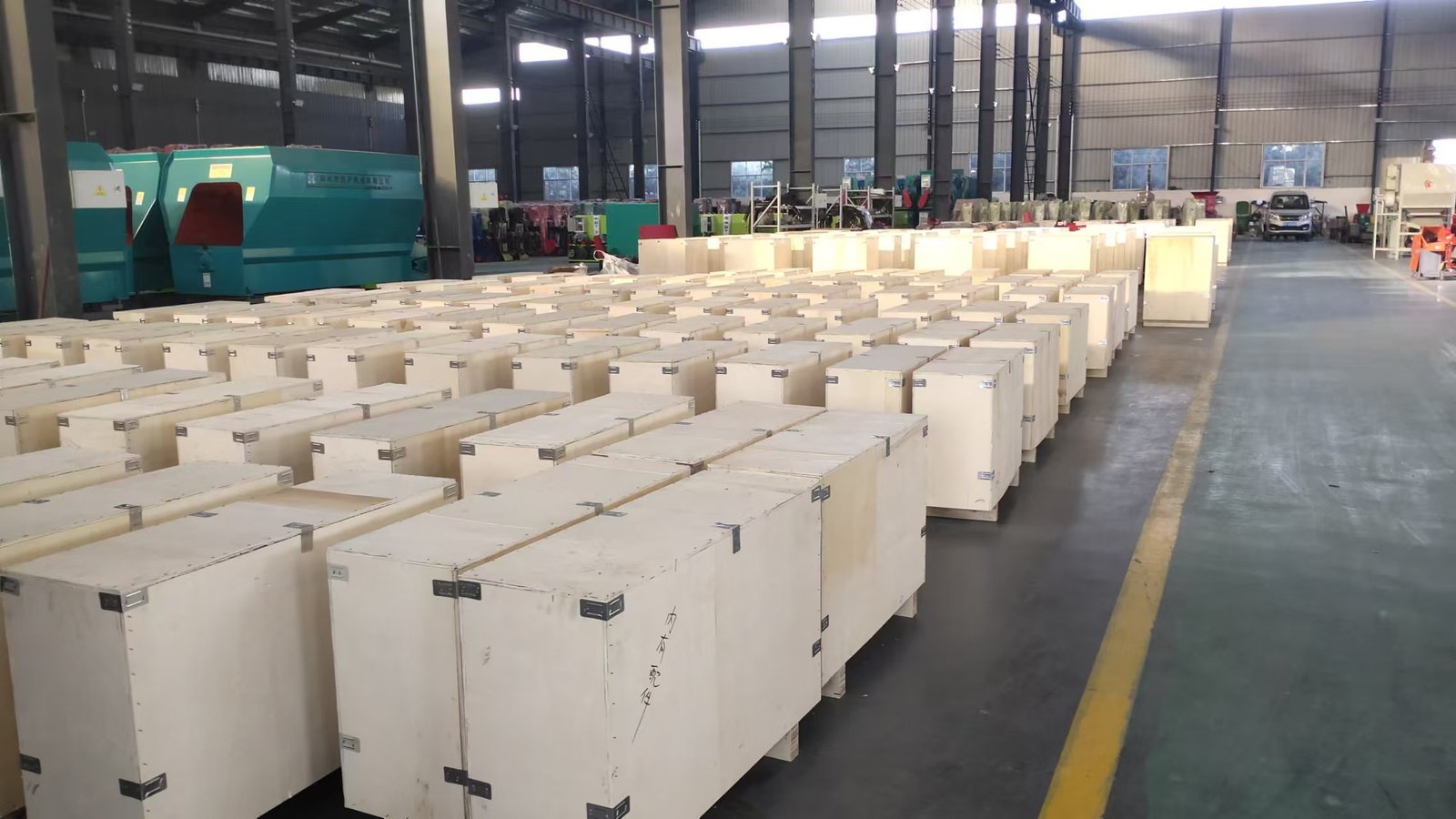
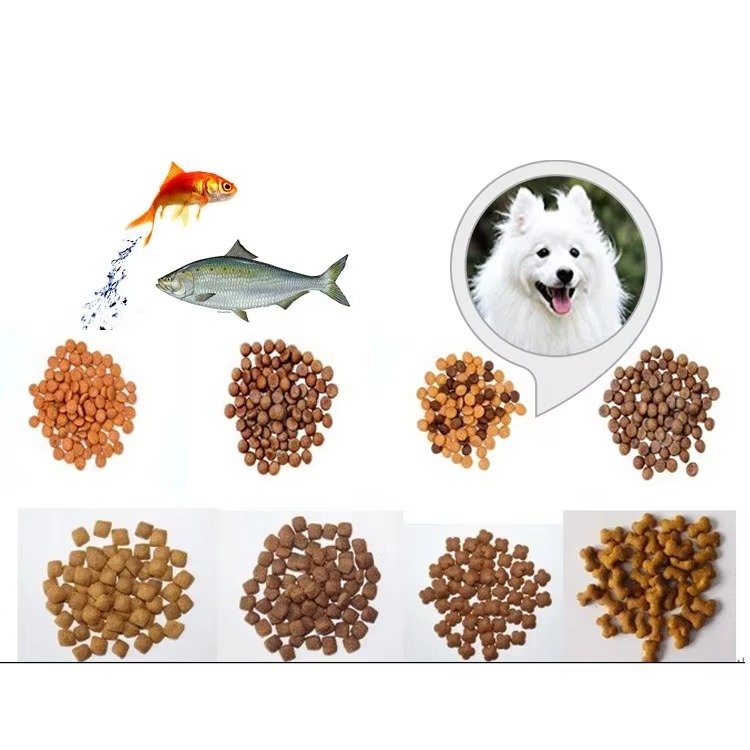
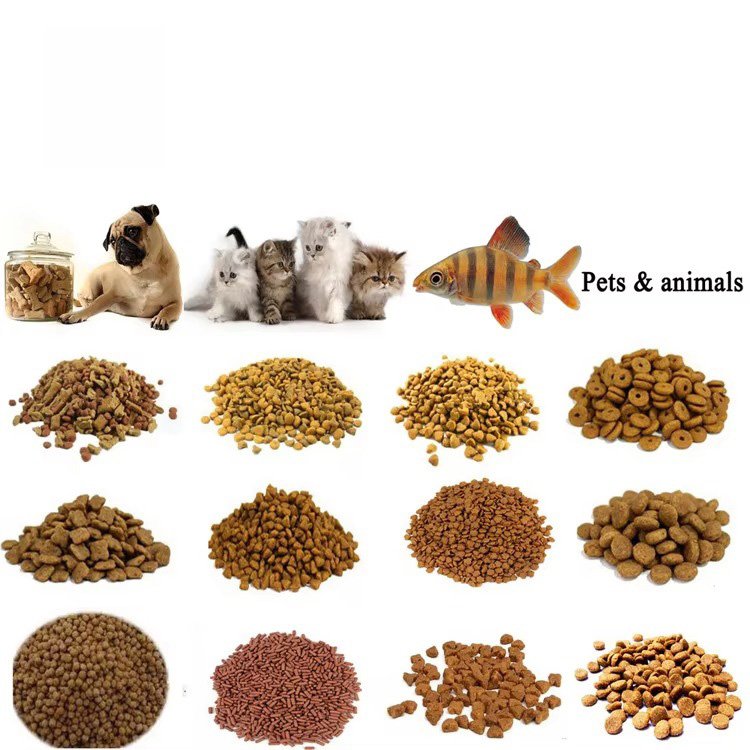
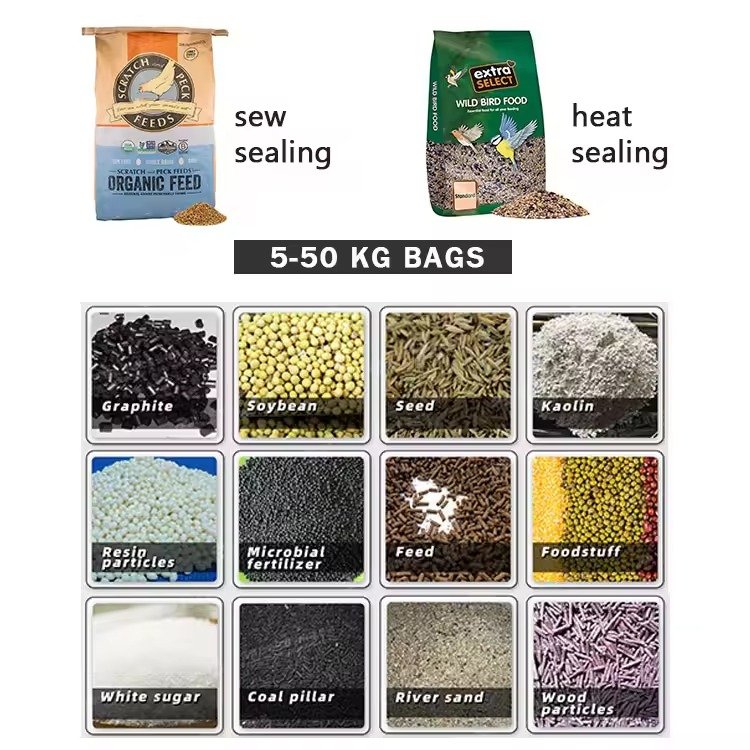
What Is a Complete Animal Feed Production Line and Why Configuration Matters
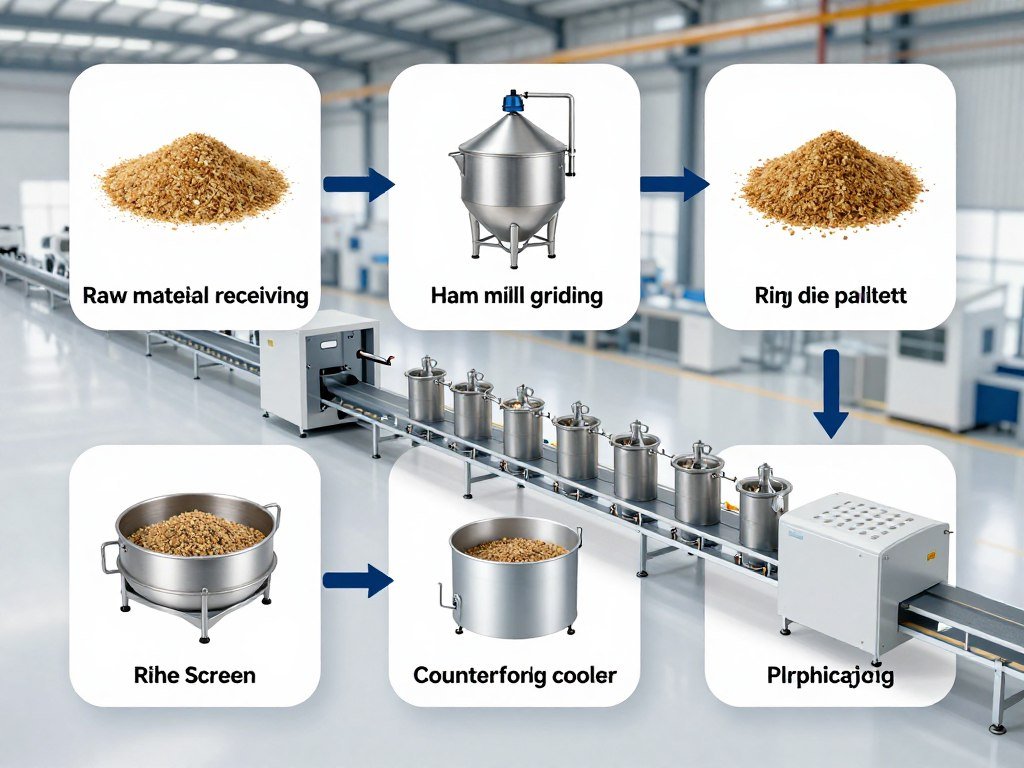
An animal feed production line transforms raw ingredients into uniform, nutritious feed pellets through six essential stages. Each stage requires specific equipment matched to your target capacity, raw materials, and animal species. Philippine feed producers commonly process corn, soybean meal, rice bran, fishmeal, copra meal, and various supplements. The production flow follows this sequence:
Essential Production Stages
- Crushing/Grinding – Hammer mills reduce whole grains and ingredients to proper particle size (1-4mm) for optimal mixing and pelleting. Philippine corn and copra require different screen sizes than imported wheat.
- Mixing – Batch or continuous mixers blend ground ingredients with supplements, vitamins, and minerals to achieve uniform distribution. Improper mixing creates nutritional imbalances in your feed.
- Pelleting/Expanding – Ring die pellet machines compress mixed ingredients into dense pellets (2-12mm diameter). Water stability for fish feed requires higher compression than poultry feed.
- Cooling – Counterflow coolers reduce hot pellet temperature from 75-85°C to ambient +5°C, preventing mold growth during storage in humid Philippine conditions.
- Screening – Vibrating screens separate oversized pellets and fines, ensuring uniform product quality and reducing waste.
- Packaging – Automatic weighing and bagging systems package finished feed pellets in 25kg or 50kg bags, ready for distribution across Luzon, Visayas, and Mindanao.
Your production capacity determines equipment sizing. A 1-ton-per-hour line serves medium farms (5,000-10,000 chickens), while 10-20 ton-per-hour systems supply commercial feed mills distributing across multiple provinces. MAIKONG Model MK-001 production lines scale from 200 kilograms per hour (ideal for small integrated farms) to 200 tons per hour (regional feed mill operations). Each component must match the system capacity—a 5-ton mixer paired with a 1-ton pellet machine creates expensive bottlenecks.
Philippine-Specific Consideration: Electrical supply varies across regions. Metro Manila and major cities provide stable 380V three-phase power suitable for industrial pellet machines. Rural areas in provinces like Palawan or Mountain Province may require 220V single-phase equipment or generator backup during brownouts. MAIKONG customizes motor specifications for your location’s electrical infrastructure.
Core Equipment Components: How Each Machine Contributes to Feed Quality
Understanding individual equipment functions helps you specify the right feed production line configuration. Philippine raw materials present unique challenges—high moisture rice bran, fibrous copra meal, and imported fishmeal all require different processing approaches. Here’s what each component does:
Hammer Mill Grinder
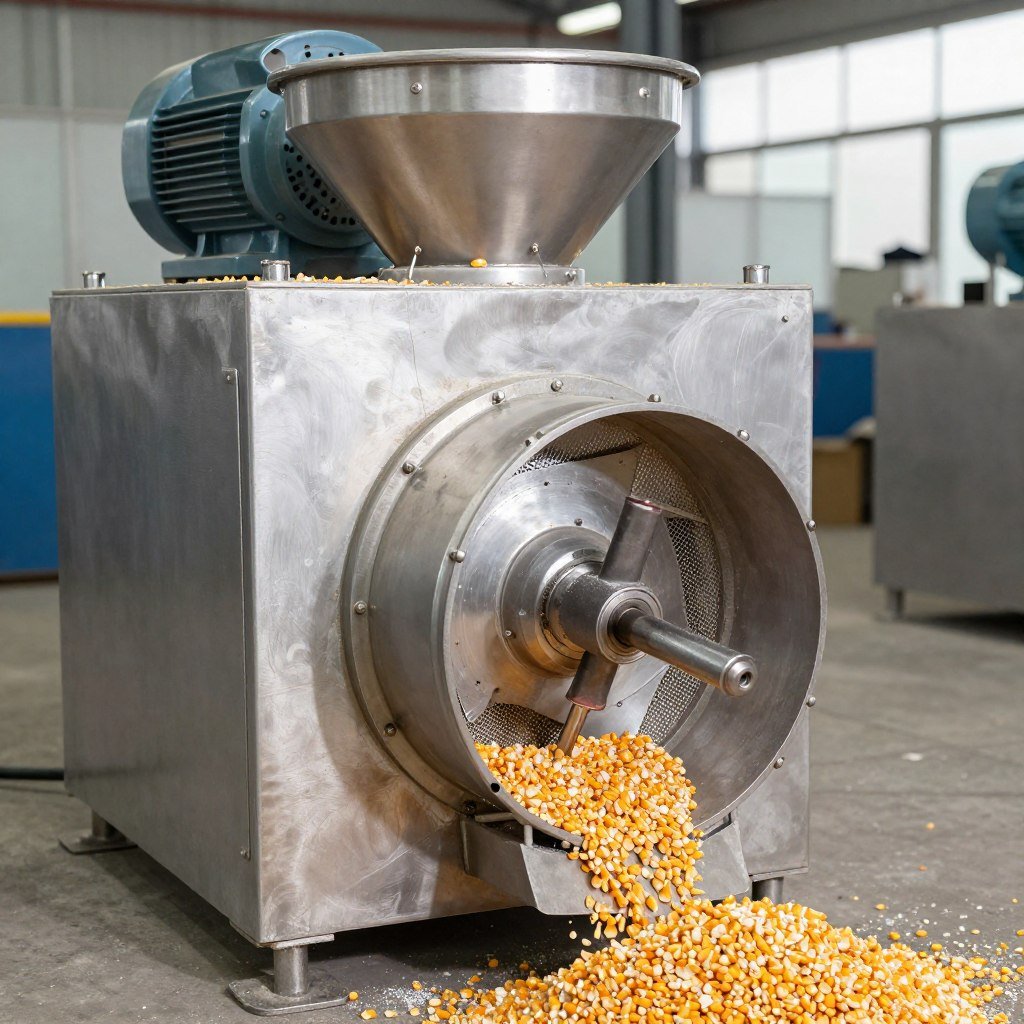
Reduces whole grains, copra, and other ingredients to optimal particle size. Screen hole diameter (2mm, 3mm, 4mm) determines final grind size. Finer grinds improve pellet quality but increase power consumption.
- Handles Philippine corn, rice bran, copra meal
- 5-150 kW motors depending on capacity
- Replaceable hammers and screens
- Dust collection system recommended
Horizontal Mixer
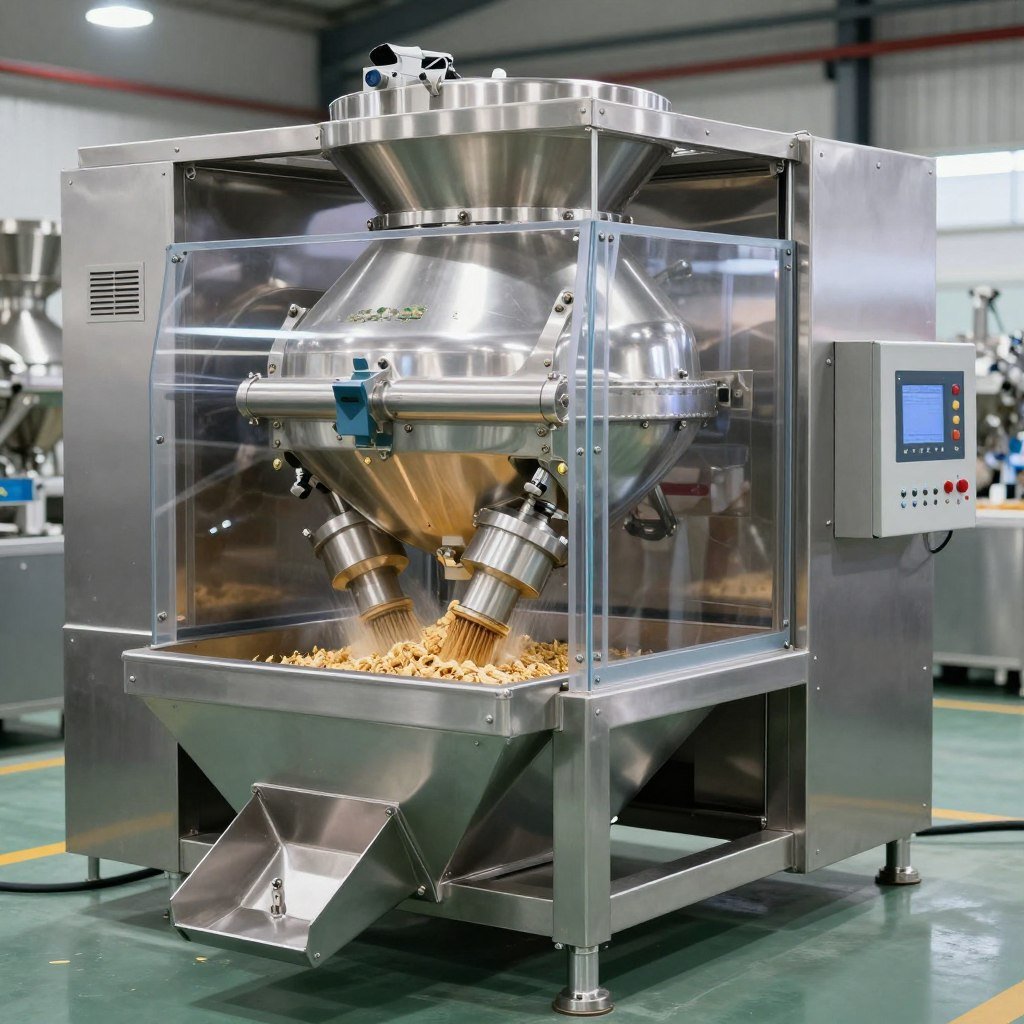
Blends ground ingredients with micro-nutrients achieving 95%+ uniformity in 5-8 minutes. Batch mixers (500kg-5,000kg) suit flexible recipe changes. Continuous mixers serve single-formula high-volume operations.
- Ribbon or paddle agitator designs
- Liquid additive injection capability
- Quick discharge for efficiency
- Easy cleaning between batches
Ring Die Pellet Mill
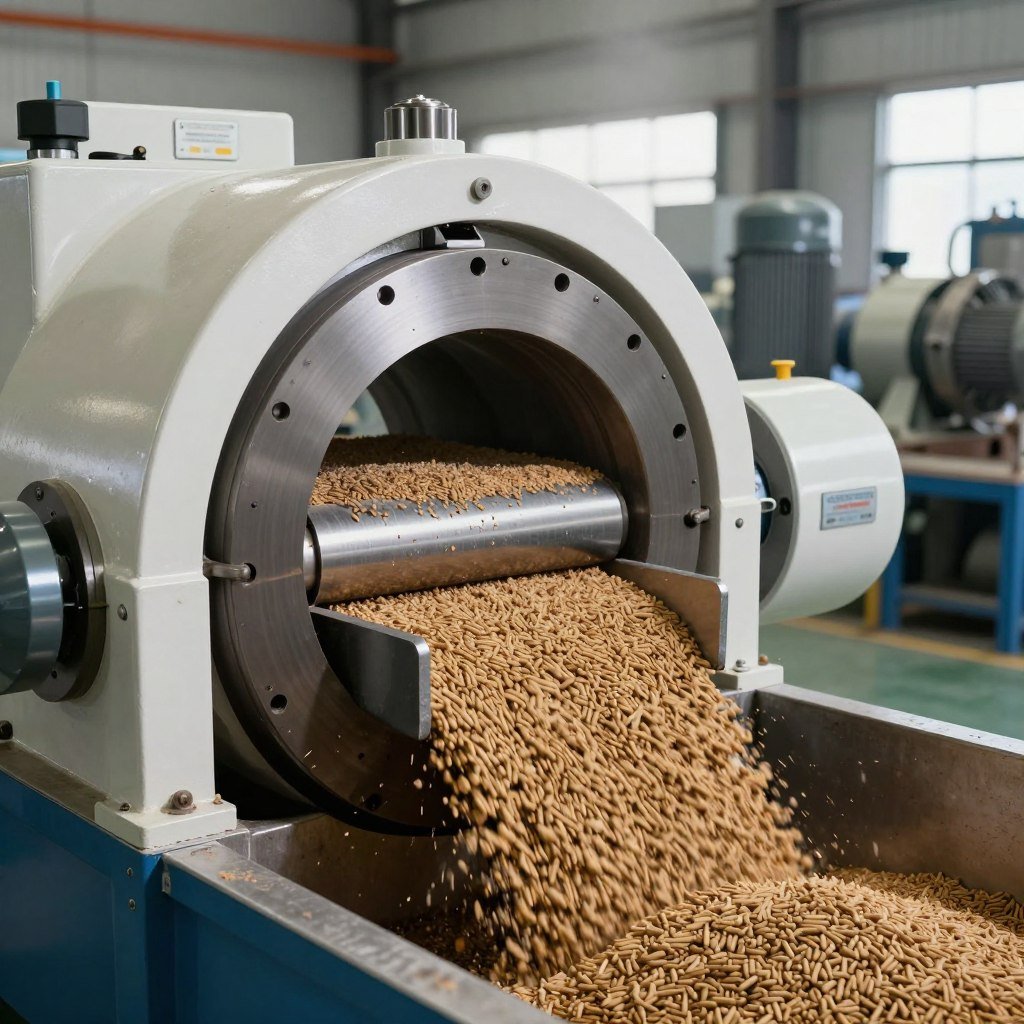
Compresses conditioned mash through die holes forming dense pellets. Die diameter (250mm-678mm) and hole diameter (2.5mm-12mm) determine capacity and pellet size. Requires 18-22% moisture for optimal pelleting.
- Stainless steel die and rollers
- Steam conditioner for starch gelatinization
- Variable frequency drive control
- Quick die change system
Counterflow Cooler
Removes heat and moisture from hot pellets using ambient air flow. Prevents mold growth during storage in 80%+ humidity Philippine conditions. Insufficient cooling ruins pellet shelf life.
- Reduces temperature to ambient +5°C
- Removes 3-5% moisture content
- Typically 10-15 minutes residence time
- Dust extraction included
Rotary Screener
Separates finished pellets from fines and oversized pieces. Fine material returns to pellet mill. Ensures uniform product meets customer specifications (98%+ intact pellets).
- Multi-deck screening capability
- Adjustable screen mesh sizes
- Low noise operation
- Minimal pellet breakage
Automatic Packaging
Weighs and bags finished feed pellets at 25kg or 50kg per bag. Electronic scales ensure accurate weights. Bag sewing or heat sealing prevents spillage during transport to farms across the archipelago.
- ±50 gram weighing accuracy
- 15-20 bags per minute speed
- Both woven and paper bag compatibility
- Automatic bag placement optional
Configure Your Complete Feed Production System
Our engineering team designs animal feed production line configurations matching your exact capacity needs, raw materials, target animals, and Philippine electrical requirements. Get a customized system proposal with detailed specifications, layout drawings, and transparent pricing.
Free consultation • 22+ years experience • Philippine voltage customization
Production Capacity Ranges: Matching Your Operation Size to the Right Equipment
Philippine feed producers operate at vastly different scales. A backyard farm raising 500 chickens needs far different equipment than a commercial integrator supplying 50,000 birds weekly. MAIKONG feed pellet production line systems span this entire range. Here’s how to determine your required capacity:
Calculating Your Needed Capacity
Estimate daily feed consumption across your animal population. Broiler chickens consume approximately 150 grams daily at peak. Layer hens need 120 grams. Growing tilapia fish eat 3-5% of body weight. Cattle require 2-3% of body weight in concentrate feed. Multiply consumption by your population to get daily requirements, then add 20-30% buffer for growth and peak demand periods.
Convert daily needs to hourly capacity by dividing by your preferred production shifts. A single 8-hour shift requires higher hourly capacity than three-shift 24-hour operations. Most Philippine feed mills run single or double shifts due to labor costs. Weekend production schedules also affect capacity planning.
Example Calculation: 10,000 broiler chickens × 150g daily = 1,500 kg per day. Running one 8-hour shift = 188 kg/hour minimum. Recommend 300-500 kg/hour (1/2 ton) system allowing capacity buffer and future expansion.
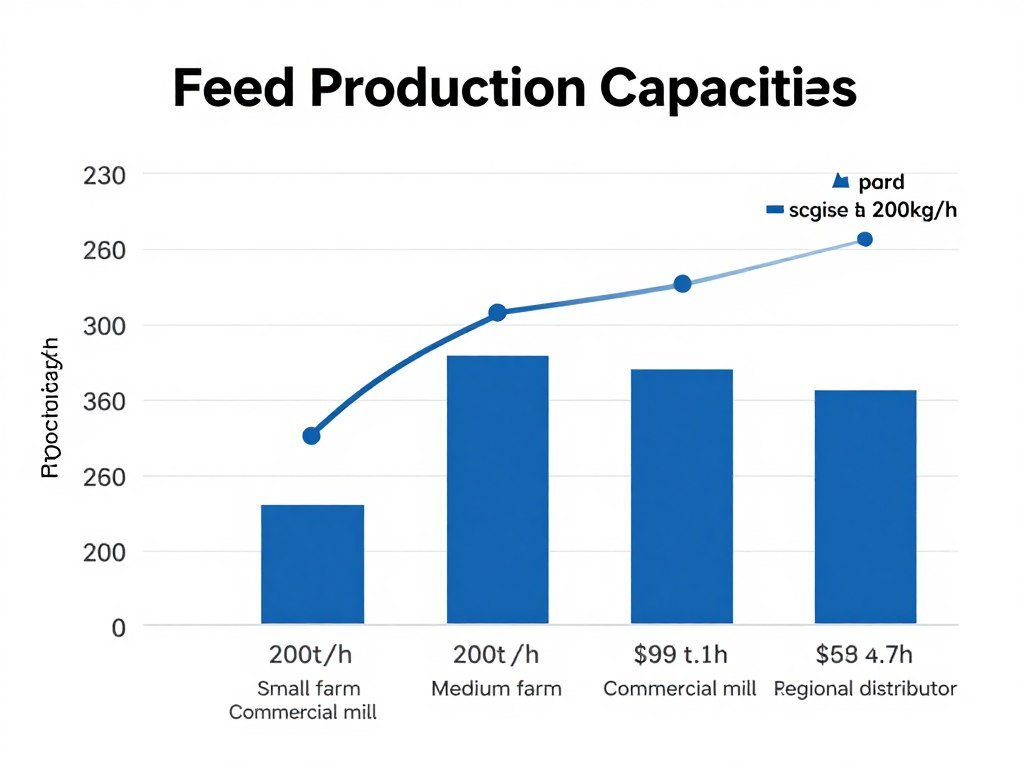
MAIKONG Model MK-001 Capacity Specifications
| Capacity Range | Typical Application | Pellet Mill Size | Main Motor Power | Dimensions (L×W×H) | Approximate Investment |
| 200-500 kg/h | Small integrated farms (1,000-5,000 birds), fish hatcheries | SZLH250 (250mm die) | 22 kW | 12m × 4m × 5m | ₱1.2M – ₱2.5M |
| 1-2 T/H | Medium poultry farms (10,000-20,000 birds), small commercial mills | SZLH320 (320mm die) | 37 kW | 18m × 6m × 6m | ₱3.5M – ₱5.5M |
| 3-5 T/H | Large farms, small feed mills serving local area | SZLH350 (350mm die) | 55 kW | 22m × 7m × 7m | ₱6M – ₱9M |
| 10-15 T/H | Commercial feed mills serving multiple farms in province | SZLH508 (508mm die) | 160 kW | 35m × 10m × 9m | ₱15M – ₱25M |
| 20-30 T/H | Regional feed mills distributing across multiple provinces | SZLH678 (678mm die) | 220 kW | 45m × 12m × 11m | ₱35M – ₱55M |
Investment estimates include complete production line equipment (crushing through packaging), electrical installation, and basic civil works. Actual costs vary based on specific configuration, automation level, building construction, and optional equipment like boiler, silos, or laboratory.
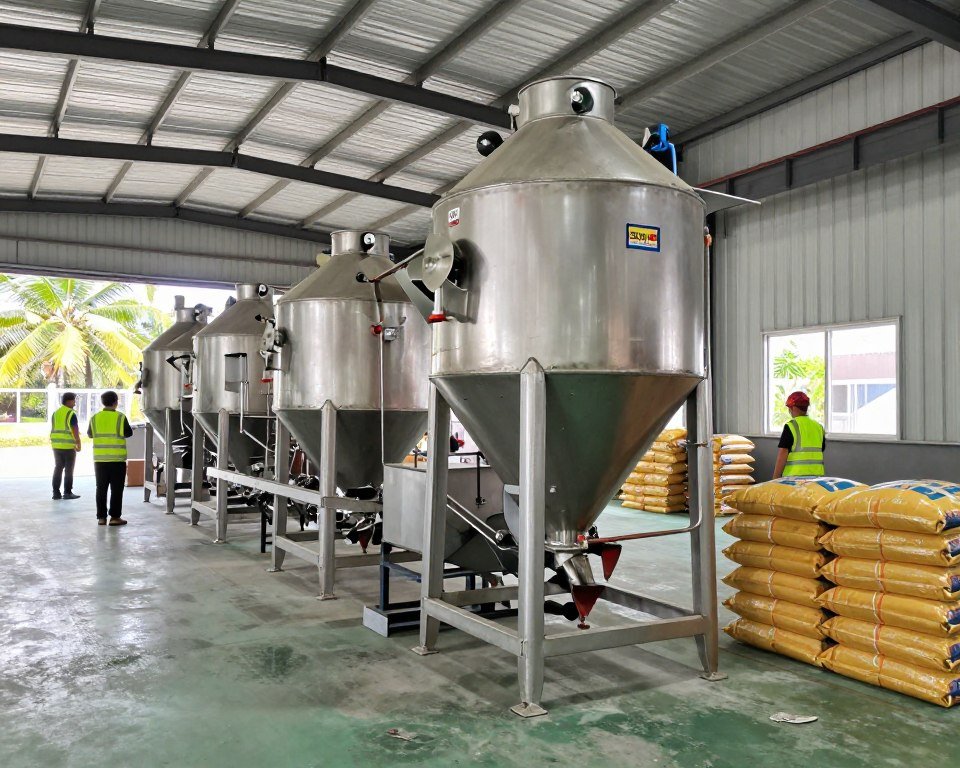
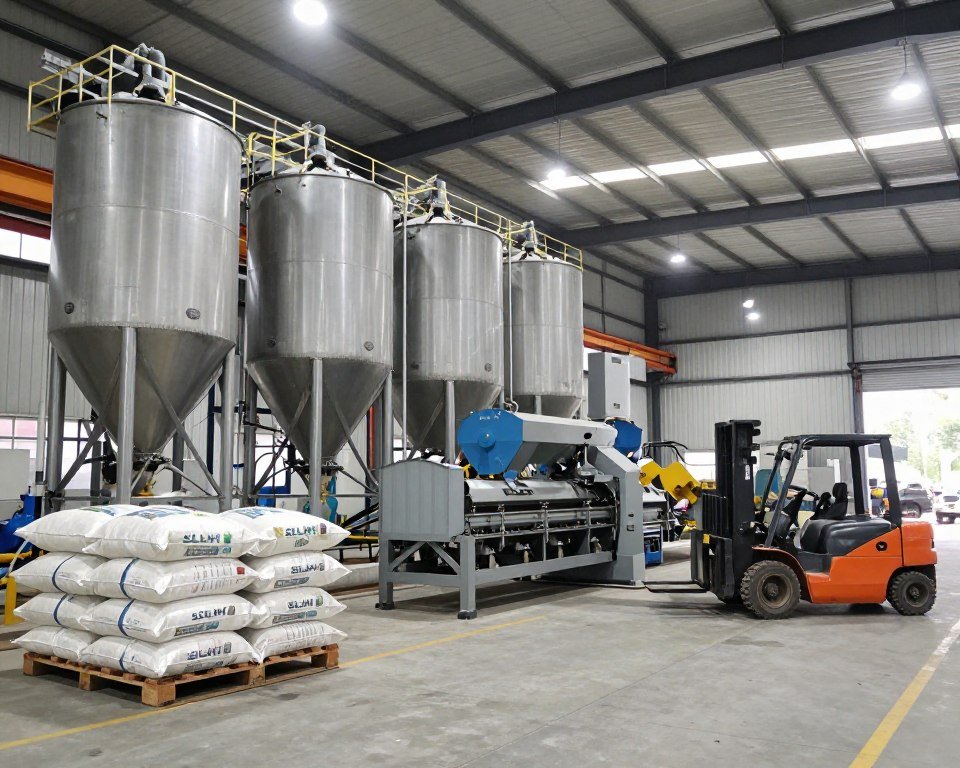
1-2 T/H Complete Line
Perfect for: Medium poultry operations (10,000-20,000 broilers), tilapia fish farms (5-10 ponds), small commercial feed distributors serving local barangays.
Includes: SZLH320 pellet mill (37kW), 1,000kg horizontal mixer, hammer mill grinder, counterflow cooler, screener, 25kg bagger.
Power requirement: 380V three-phase, 80kW total installed power.
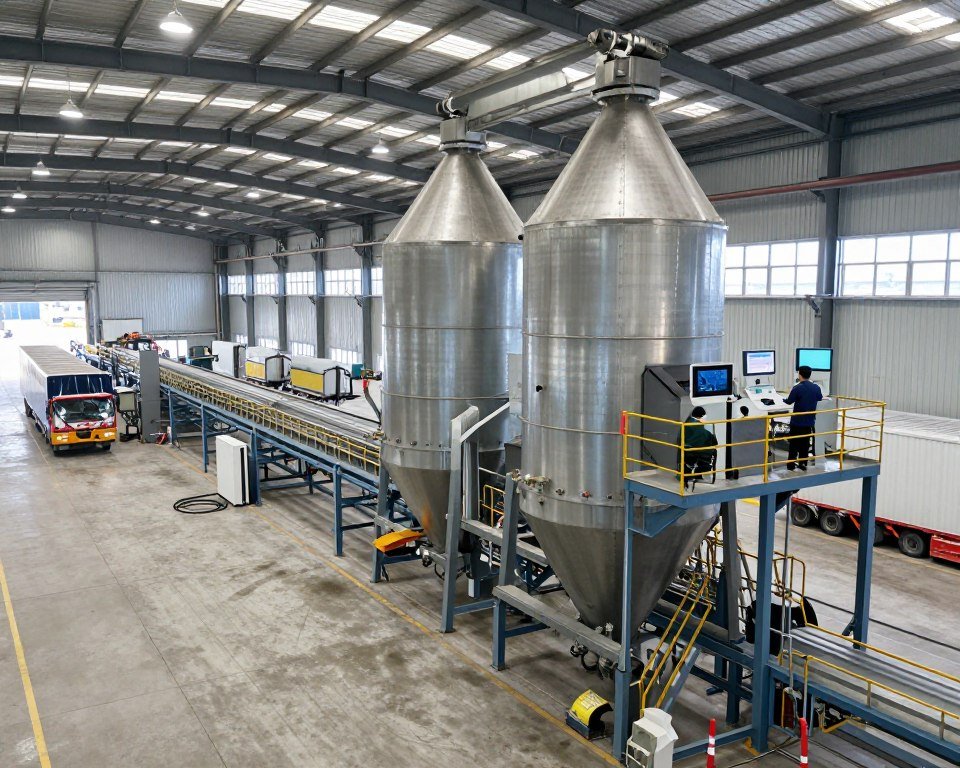
5-6 T/H Commercial System
Perfect for: Large layer farms (50,000+ hens), cattle feedlots, commercial mills supplying dealers across the province, multi-species feed producers.
Includes: SZLH420 pellet mill (110kW), 3,000kg batch mixer, dual hammer mills, cooler, screener, automatic packaging with bag stacker.
Power requirement: 380V three-phase, 180kW total, recommend dedicated transformer.
15-20 T/H Regional Mill
Perfect for: Regional feed distributors, integrator operations supplying contract growers, export-oriented feed producers, multi-province distribution networks.
Includes: Dual SZLH508 pellet mills (160kW each), continuous mixer, multiple grinding circuits, pneumatic conveying, automated batching, PLC control system.
Power requirement: 380V three-phase, 400kW+ total, dedicated substation required.
Philippine Raw Materials and Recipe Formulation: Maximizing Local Ingredient Use
Successful feed manufacturing in the Philippines depends on understanding local ingredient availability, pricing, and nutritional characteristics. Unlike Western markets relying heavily on corn and soybean meal, Philippine producers blend diverse materials. Your production line configuration must handle these specific ingredients:
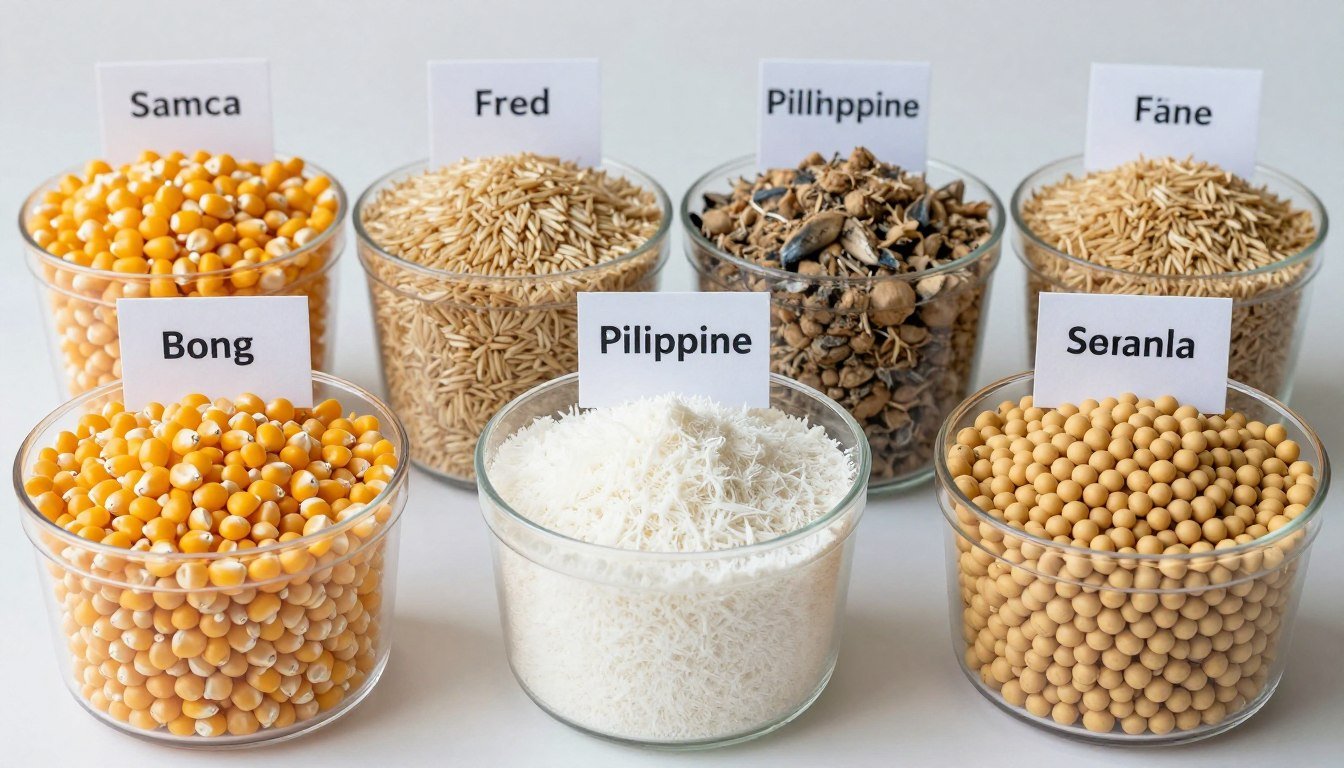
Energy Sources
These ingredients provide calories for animal growth and maintenance. Selection depends on local availability and cost per megajoule of energy.
- Yellow Corn – Primary energy source, 70-80% of poultry diets. Philippine corn from Isabela, Cagayan, and Bukidnon provinces. Requires 3mm screen in hammer mill for optimal pelleting.
- Rice Bran – By-product from rice milling, abundant and economical. Contains 12-15% oil, limit to 15-20% of diet to prevent rancidity. Higher fiber requires longer conditioning.
- Wheat Bran – Imported or from local mills. Palatable filler ingredient. High fiber limits use to 10-15% in monogastric diets, higher in ruminant feeds.
- Cassava Chips – Alternative energy source in Mindanao regions. Lower protein than corn, requires protein supplementation. Excellent pelleting characteristics.
Protein Sources
Provide amino acids essential for muscle development, egg production, milk synthesis, and growth. Most expensive feed components require careful formulation.
- Soybean Meal – Gold standard protein source, 44-48% crude protein. Mostly imported, price volatile. Essential for high-performance poultry and swine.
- Fishmeal – Domestic production from bycatch and fish processing waste. 58-65% protein with excellent amino acid profile. Critical for aquaculture feeds and starter diets.
- Copra Meal – Coconut oil extraction by-product, abundant in Visayas and Mindanao. 20-22% protein. Limits: high fiber, limit to 15% in poultry, 30% in cattle.
- Full-Fat Soybean – Heat-treated soybeans provide both protein (38%) and energy (18% fat). Requires proper roasting equipment before use.
Mineral & Vitamin Sources
Micronutrients support bone development, enzyme function, immune response, and metabolic processes. Small quantities have major impact on animal performance.
- Limestone (Calcium Carbonate) – Crushed shells or mined limestone, 38% calcium. Essential for layer hens (eggshell formation) and bone growth. Requires fine grinding, avoid dust.
- Dicalcium Phosphate – Provides phosphorus and calcium. Expensive, use calculated amounts. Critical for young growing animals.
- Salt (Sodium Chloride) – Electrolyte balance and palatability. Maximum 0.5% of diet. Overdose causes toxicity, underdose reduces intake.
- Premix – Commercial vitamin-mineral-amino acid concentrate. Typically 0.5-1% of diet. Source from reputable suppliers, improper storage loses potency.
Feed Additives
Enhance feed quality, preserve freshness, improve digestibility, and promote animal health. Proper incorporation requires adequate mixer capacity.
- Enzymes – Phytase releases phosphorus from plant materials, reducing dicalcium phosphate cost. Xylanase improves wheat/barley digestibility. Heat-sensitive, add after pelleting.
- Mold Inhibitors – Organic acids (propionic, formic) prevent fungal growth in humid storage. Essential in Philippine wet season (June-November).
- Probiotics/Prebiotics – Beneficial bacteria improve gut health and feed conversion. Growing market segment for premium feeds.
- Pigments – Marigold extract for egg yolk color, canthaxanthin for broiler skin. Important for consumer appeal in Philippine markets.
Sample Feed Formulations for Philippine Production
| Ingredient | Broiler Starter (0-3 weeks) | Layer Grower (8-18 weeks) | Tilapia Grow-Out | Cattle Fattening |
| Yellow Corn | 54% | 60% | 30% | 45% |
| Soybean Meal (44%) | 38% | 22% | 25% | 8% |
| Rice Bran | – | 8% | 15% | 15% |
| Fishmeal (60%) | 5% | 3% | 18% | – |
| Copra Meal | – | – | 8% | 25% |
| Limestone | 1.2% | 1.5% | 1% | 0.5% |
| Dical Phosphate | 0.8% | 1.5% | 2% | 0.5% |
| Salt | 0.3% | 0.3% | 0.5% | 0.5% |
| Premix | 0.5% | 0.5% | 0.5% | 0.5% |
| Methionine | 0.2% | 0.2% | – | – |
| Crude Protein | 21-22% | 16-17% | 28-30% | 14-16% |
| Energy (ME kcal/kg) | 3,000 | 2,800 | 2,900 | 2,600 |
Formulations shown are starting points. Adjust based on specific ingredient analysis, animal performance, and local prices. Consult animal nutritionist for optimized recipes. MAIKONG provides free formulation consultation with production line purchase.
Critical Raw Material Handling: High-oil ingredients (rice bran, copra meal, full-fat soy) oxidize rapidly in tropical heat. Store in cool, dry conditions maximum 30 days. Fishmeal attracts pests and absorbs moisture—store in sealed containers with desiccant. Limestone dust creates respiratory hazards—ensure proper ventilation during grinding.
Successful MAIKONG Installations: Real Projects Across Philippines, Asia, and Beyond
MAIKONG has delivered animal feed production line systems to over 500 customers across continents. These real project examples demonstrate our experience handling diverse requirements, locations, and scales. Each installation includes equipment supply, technical training, installation supervision, and ongoing support.
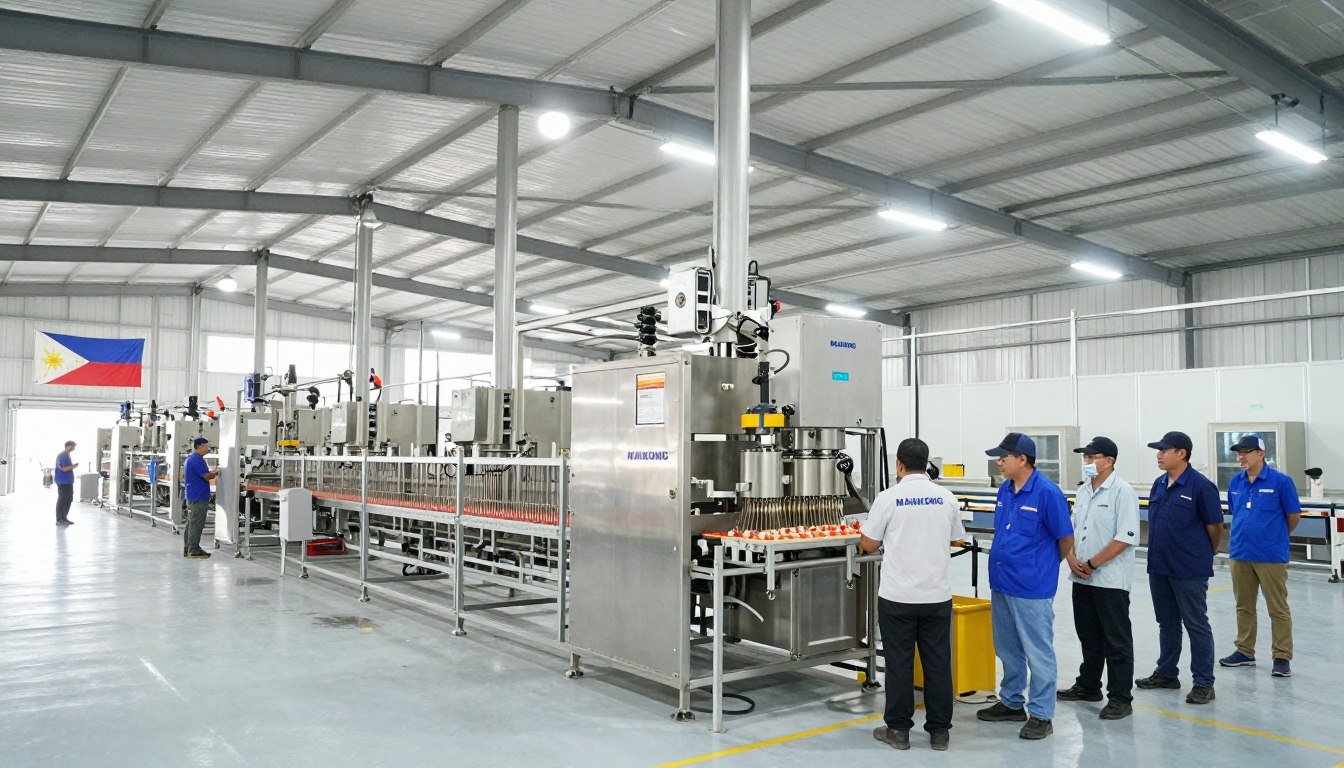
Bulacan Poultry Farm, Philippines
Capacity: 2 T/H poultry feed line
Challenge: Medium-sized layer operation (15,000 hens) wanted independence from commercial feed suppliers. Limited floor space in existing building required compact layout. Unreliable grid power (frequent brownouts) needed backup consideration.
Solution: MAIKONG designed vertical layout maximizing limited space. SZLH320 pellet mill with 37kW motor operates on farm’s existing 380V supply. Added automatic transfer switch for generator backup during outages. Installed dust collection on grinder to prevent respiratory issues in enclosed building.
Result: Farm now produces layer feed at ₱18/kg vs. ₱24/kg commercial purchase. System paid for itself in 18 months. Capacity allows contract manufacturing for neighboring farms, creating additional revenue stream.
Pampanga Fish Feed Mill, Philippines
Capacity: 5 T/H fish feed sinking pellets
Challenge: Commercial mill serving tilapia farmers across Central Luzon needed high water stability pellets (minimum 2 hours in water without disintegration). Existing equipment produced soft pellets that dissolved quickly, causing water quality problems and wasted feed.
Solution: MAIKONG installed SZLH420 pellet mill with extended steam conditioning chamber (30-second residence time vs. standard 15 seconds). Higher compression die specification (1:12 ratio) and stainless steel construction for fishmeal’s corrosive oils. Post-pellet oil coating system adds palatability while enhancing water resistance.
Result: Pellets now maintain integrity 3+ hours in water. Customer complaints dropped 85%. Mill increased market share from 12% to 31% in their region within one year. Processing tilapia, bangus (milkfish), and catfish formulations on same line.
Mindanao Cattle Ranch, Philippines
Capacity: 1 T/H cattle finishing feed
Challenge: Large cattle operation (800 head) in remote area outside Davao City. No three-phase power available, only single-phase 220V residential service. High fiber local ingredients (copra meal, rice straw) difficult to pellet. Seasonal rainfall creates mud, complicating raw material handling.
Solution: MAIKONG engineered single-phase motor package for entire line (rare in commercial systems). Upgraded grinder with 2mm screen and longer hammer residence time to handle fibrous materials. Elevated storage hoppers prevent mud contamination. Designed covered material receiving area for year-round operation.
Result: Ranch now produces complete ration pellets including forage, eliminating separate hay feeding. Improved average daily gain from 0.7kg to 0.95kg. Reduced feed conversion ratio (FCR) from 8.5:1 to 6.8:1, saving ₱450 per head to market weight.
Malaysia Shrimp Feed Expansion
Capacity: 10 T/H aqua feed expanding pellets
Challenge: Existing 5 T/H system couldn’t meet growing demand from vannamei shrimp farms. Needed seamless expansion without disrupting current production. Required slow-sinking pellets (30-40% floatation) for shrimp feeding behavior.
Solution: MAIKONG installed parallel 5 T/H line sharing common raw material storage and packaging. Dual SZLH420 mills run independently or together for 10 T/H total. Specialized expander pre-conditions material, creating partially gelatinized pellet with controlled density. Recipe flexibility allows switching between sinking, slow-sink, and floating formulations.
Result: Doubled capacity with only 60% additional floor space. Flexibility to produce multiple pellet types simultaneously. Expansion commissioned in 45 days with zero production downtime on original line.
Vietnam Multi-Species Mill
Capacity: 8 T/H complete feed for poultry, pig, fish
Challenge: Commercial mill wanted single production line serving three distinct markets: broiler feed, swine grower, and catfish feed. Each requires different pellet sizes and formulations. Frequent recipe changes needed efficient cleaning.
Solution: MAIKONG designed quick-change die system on SZLH508 pellet mill (swap dies in 20 minutes vs. 2+ hours standard). Installed separate micro-ingredient batching for precise premix addition per species. Automated mixer cleaning cycle between batches prevents cross-contamination. Variable frequency drives allow adjusting pellet mill speed for different formulations.
Result: Mill produces 6 different feed types on single line, changing products 2-3 times daily. Eliminated need for dedicated lines per species, saving ₱12M in capital cost. Serves 200+ farms across three provinces.
Uganda Poultry Cooperative
Capacity: 3 T/H layer and broiler feed
Challenge: Farmer cooperative (45 members, 120,000 total birds) needed consistent feed supply at stable prices. Import dependence on Kenyan feed created supply interruptions and currency exchange risks. Limited technical expertise among members.
Solution: MAIKONG provided turnkey installation including operator training, formulation development, and first-year technical support. Simple control system designed for operators with basic technical education. Comprehensive spare parts package shipped with initial equipment. Ongoing remote support via WhatsApp video calls.
Result: Cooperative achieved feed independence, stabilizing member farm economics. Increased production to serve non-member farms, generating profit that funds additional cooperative services. Three members now certified feed mill operators after MAIKONG training program.
Join 500+ Successful Feed Producers Across Asia, Americas, Europe & Africa
MAIKONG animal feed production line systems operate in challenging conditions worldwide—from tropical Philippines humidity to African dust to Middle Eastern heat. Our engineering team has solved problems you haven’t encountered yet. Request a custom project proposal based on your specific location, raw materials, target species, and capacity requirements.
Delivered to Philippines, Malaysia, Vietnam, Indonesia, Peru, Mexico, Uganda, and 130+ countries
Installation, Training, and Technical Support: Ensuring Your Production Line Success
Purchasing equipment represents only the first step. Successful feed production requires proper installation, operator competency, and responsive technical support. MAIKONG provides comprehensive services ensuring your animal feed production line achieves design capacity and maintains performance for decades.
Installation Services
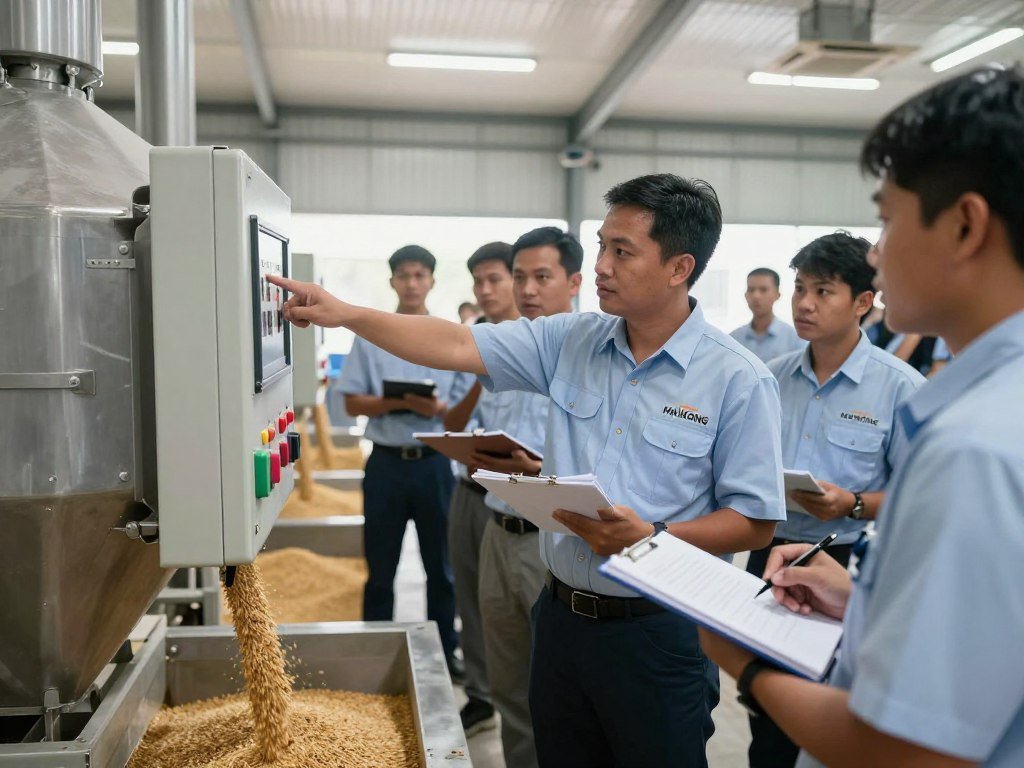
Our installation team supervises equipment assembly, electrical connections, and commissioning. This ensures compliance with design specifications and prevents costly startup errors.
- Pre-Installation Planning: Review building layout, electrical supply, raw material flow, finished product storage. Identify potential issues before equipment arrives. Recommend civil works modifications if needed.
- Equipment Positioning: Supervise machinery placement using laser alignment tools. Proper alignment prevents premature bearing wear and vibration issues. Anchor points designed for Philippine seismic activity.
- Electrical Installation: Verify motor voltage matches local supply (220V or 380V). Check phase balance, grounding, overload protection. Commission variable frequency drives and control systems.
- Pneumatic Conveying: Design and install air conveying for dust-free material transfer. Size blowers for Philippine humidity and altitude. Prevent segregation of mixed ingredients during transport.
- Commissioning Tests: Run empty line checking rotation, noise, vibration. Process test batches verifying mixing uniformity, pellet quality, cooler performance. Adjust parameters to achieve specification.
- Performance Verification: Operate at rated capacity for 8-hour continuous run. Measure throughput, power consumption, pellet durability index (PDI). Provide written performance guarantee.
Operator Training Program
Comprehensive training transforms your staff into skilled feed mill operators capable of independent operation, routine maintenance, and basic troubleshooting.
Production Operations Training (3-5 days)
- Ingredient receiving, quality checks, storage management
- Formula batching accuracy and documentation
- Grinding screen selection and hammer replacement
- Mixer operation, batch timing, cleaning procedures
- Pellet mill startup, die conditioning, troubleshooting
- Cooler airflow adjustment and temperature monitoring
- Packaging system operation and bag weight calibration
- Daily, weekly, monthly maintenance checklists
- Safety procedures and emergency shutdown
Maintenance Training (2-3 days)
- Bearing lubrication schedules and grease types
- Belt tension checking and replacement
- Die and roller inspection, when to replace
- Mixer paddle wear assessment
- Electrical panel basics, fuse replacement
- Pneumatic system filter cleaning
- Common spare parts inventory management
Quality Control Training (2 days)
- Pellet durability index (PDI) testing using tumbler
- Moisture content measurement (critical for storage)
- Pellet length and diameter verification
- Water stability testing for aqua feeds
- Mixing uniformity CV% testing for salt/premix
- Ingredient quality assessment (visual, moisture, protein)
Training Language: All training conducted in English, the business language of the Philippines. Training manuals provided in English with visual diagrams. MAIKONG instructors experienced teaching across language barriers using demonstration and hands-on practice.
Ongoing Technical Support
Problems don’t wait for business hours. MAIKONG provides multiple support channels ensuring minimal downtime when issues arise.
WhatsApp Technical Hotline
Direct messaging to engineering team: +8615815556422
Video call capability for visual troubleshooting. Share photos/videos of problems. Typical response time: Within 2 hours during Asian business hours (8 AM – 10 PM Manila time), next business day for non-urgent inquiries.
Common issues resolved remotely: Control settings, parameter adjustments, ingredient formulation questions, minor mechanical troubleshooting.
Email Technical Support
Detailed inquiries: Lucy@pelletmachine.ph
For complex problems requiring documentation, CAD drawings, spare parts identification, or formulation consultation. Response within 24 hours including weekends for urgent production-stopping issues.
Request technical bulletins on specific topics: seasonal raw material changes, new ingredient incorporation, capacity upgrades, automation additions.
On-Site Service Visits
Schedule technician visits for major overhauls, capacity upgrades, or issues requiring hands-on diagnosis. MAIKONG maintains service partnerships with equipment distributors in Manila, Cebu, and Davao for faster Philippine response.
Typical visit duration: 2-5 days depending on scope. Services include: Annual maintenance inspections, die/roller replacement, production optimization audits, operator refresher training.
Spare Parts Availability
Proactive spare parts stocking prevents costly production interruptions. MAIKONG recommends establishing initial inventory of wear components based on your production volume.
| Component | Expected Life | Recommended Stock | Lead Time (Philippines) |
| Pellet Mill Die | 1,000-3,000 operating hours | 1 spare (2 total with installed) | 30-45 days shipping |
| Pellet Mill Rollers | 2,000-5,000 hours | 1 set spare | 30-45 days |
| Hammer Mill Hammers | 500-1,000 hours (copra/rice bran) to 2,000 hours (corn) | 1 complete set | 15-20 days air freight |
| Hammer Mill Screens | 1,000-2,000 hours | 2-3 screens (common sizes 2mm, 3mm) | 15-20 days |
| Mixer Paddles | 5,000-10,000 hours | Monitor wear, order when 30% worn | 30 days |
| Drive Belts (V-belts) | 3,000-5,000 hours | 1 set per belt type | Available locally Manila/Cebu |
| Main Motor Bearings | 10,000-20,000 hours | 1 set for pellet mill motor | Available locally (SKF, NSK dealers) |
Lead times assume sea freight from MAIKONG manufacturing facility. Air freight available for urgent needs at premium cost (3-5 days to Philippines). Stocking critical parts eliminates production downtime waiting for shipping.
Customization for Philippine Market: Voltage, Climate, and Local Needs
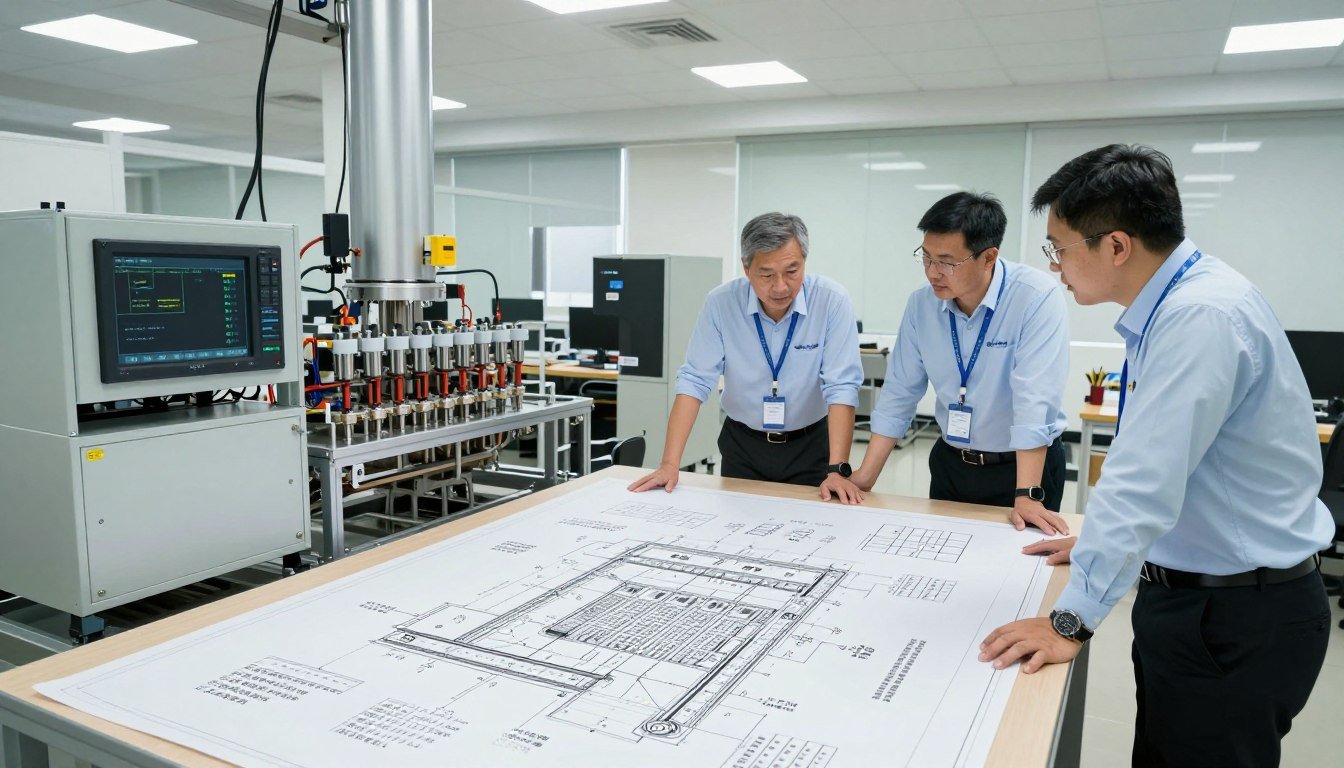
Generic imported equipment often fails in Philippine conditions. MAIKONG customizes every animal feed production line for tropical operation, local electrical supply, available raw materials, and regulatory requirements.
Electrical Customization
Philippines uses inconsistent electrical standards across regions. MAIKONG engineers systems matching your exact supply.
- Voltage Options: 220V single-phase (small systems, rural areas), 380V three-phase (commercial systems, industrial areas), 440V three-phase (rare, some industrial zones). Specify your actual measured voltage and frequency (60 Hz standard).
- Power Quality: Voltage fluctuation common in Philippine grid (±10-15% variation). MAIKONG includes voltage stabilizers for sensitive control systems. Surge protection prevents damage from lightning strikes common in monsoon season.
- Generator Compatibility: Many Philippine farms operate generators during brownouts. Motors and VFDs configured for generator power quality (higher harmonic distortion than grid). Automatic transfer switch optional.
- Energy Efficiency: Premium efficiency motors (IE3 standard) reduce operating cost. Variable frequency drives on major motors optimize power consumption per ton produced. Critical given Philippine electricity rates (₱9-13/kWh commercial).
Climate Adaptations
Tropical heat and humidity destroy equipment designed for temperate climates. MAIKONG builds for Philippine conditions.
- Corrosion Protection: Stainless steel construction for components contacting fishmeal, molasses, or acids. Powder coat paint systems resist humid salt air near coastal locations. Regular lubrication points accessible for maintenance in heat.
- Cooling System Sizing: Pellet coolers designed for 30-35°C ambient temperature, 80-90% relative humidity. Standard designs assume 20°C temperate climate and fail in tropics. Oversized cooling air volume compensates.
- Dust Management: Tropical humidity causes dust to cake and clog filters. MAIKONG uses pulse-jet bag filters that automatically clean. Critical in rice bran and copra meal processing.
- Motor Cooling: Totally Enclosed Fan Cooled (TEFC) motors prevent dust ingestion while maintaining cooling in still tropical air. Oversized cooling fans handle high ambient temperatures without derating.
Raw Material Flexibility
Philippine ingredient availability and pricing fluctuates seasonally. Flexible production line adapts to formulation changes.
- Multi-Ingredient Grinding: Hammer mills configured for both hard materials (corn, copra) and soft materials (rice bran, wheat). Easily change screens to accommodate formulation shifts based on ingredient pricing.
- High-Oil Processing: Rice bran (15% oil), copra meal (8% oil), and full-fat soy (18% oil) create challenges. Die surfaces and cooler configurations prevent oil buildup and rancidity.
- Fiber Handling: Copra meal, rice bran, and forages have high fiber content (20-40% crude fiber). Dies with wider compression angles prevent plugging. Longer conditioning time improves pelleting.
- Moisture Variation: Monsoon season (June-November) raises corn and rice bran moisture from 12% to 18%+. Adjustable steam addition compensates, maintaining pellet quality regardless of ingredient moisture.
Regulatory Compliance
Philippine feed industry operates under Department of Agriculture (DA) and Bureau of Animal Industry (BAI) regulations. MAIKONG systems meet requirements.
- Food Safety: Stainless steel contact surfaces meet Philippine National Standards (PNS) for feed safety. Prevents contamination with heavy metals (lead, cadmium) or pathogens (Salmonella, E. coli).
- Labeling Compliance: Packaging systems accommodate required label information per Republic Act 10611 (Food Safety Act). Includes ingredient declaration, guaranteed analysis, feeding instructions, and manufacturer details.
- Environmental Standards: Dust collection systems meet DENR (Department of Environment and Natural Resources) air quality standards. Noise levels below 85 dBA protect worker hearing per DOLE regulations.
- Electrical Safety: Installations comply with Philippine Electrical Code (PEC). Grounding, circuit protection, emergency stops meet Occupational Safety and Health Standards.
OEM/ODM Customization Services
MAIKONG manufactures feed pellet production line equipment under your brand for dealers, distributors, and private label customers. Our OEM/ODM program enables you to offer complete production systems without manufacturing investment.
OEM (Original Equipment Manufacturer)
- MAIKONG manufactures to your specifications
- Your brand name on equipment nameplates
- Your company logo on control panels
- Custom paint colors matching your brand
- You handle sales, installation, customer support
- Minimum order: 3 complete systems or 10 individual machines
- Typical lead time: 60-90 days production + shipping
ODM (Original Design Manufacturer)
- MAIKONG designs custom systems for your market
- Unique configurations not in standard catalog
- Specialized capacities or ingredients
- Proprietary features or innovations
- Joint intellectual property agreements
- Exclusive territory distribution rights available
- Engineering collaboration from concept to production
Contact Lucy@pelletmachine.ph to discuss OEM/ODM opportunities for your distribution business, feed mill operation, or agricultural project. MAIKONG supports partners with technical training, marketing materials, and spare parts programs.
Investment Requirements and Return on Investment: Understanding Total Costs
Philippine feed producers want transparency on complete project costs, not just equipment prices. Here’s realistic investment breakdown for animal feed production line systems at various scales.
Complete Project Investment Components
| Cost Category | 1-2 T/H System | 5-6 T/H System | 15-20 T/H System | Notes |
| Equipment (FOB) | ₱2.8M – ₱3.5M | ₱6.5M – ₱8.5M | ₱18M – ₱25M | Core machinery: grinder through packaging |
| Shipping to Philippines | ₱280K – ₱420K | ₱650K – ₱850K | ₱1.8M – ₱2.5M | Sea freight to Manila/Cebu, 30-45 days transit |
| Import Duties & Taxes | ₱420K – ₱560K | ₱975K – ₱1.3M | ₱2.7M – ₱3.8M | Varies by HS code, customs broker fees |
| Installation & Training | ₱350K – ₱500K | ₱650K – ₱900K | ₱1.5M – ₱2.2M | MAIKONG supervisor + local contractor |
| Civil Works | ₱800K – ₱1.2M | ₱2M – ₱3.5M | ₱6M – ₱10M | Building, foundation, electrical, varies by location |
| Initial Raw Materials | ₱400K – ₱600K | ₱1M – ₱1.5M | ₱3M – ₱5M | 30 days working inventory |
| Spare Parts Stock | ₱200K – ₱300K | ₱450K – ₱650K | ₱1.2M – ₱1.8M | Dies, hammers, belts, bearings |
| TOTAL INVESTMENT | ₱5.3M – ₱7.1M | ₱12.2M – ₱17.2M | ₱34M – ₱51M | Turnkey ready-to-operate |
Investment estimates based on Q1 2024 pricing and typical project scope. Civil works costs highly variable depending on existing building vs. new construction, location (Metro Manila vs. provinces), and site conditions. Contact MAIKONG for project-specific quotation.
Operating Cost Per Ton Produced
Understanding production economics helps you price competitively while ensuring profitability. Here’s typical cost breakdown per ton of finished feed pellets:
Cost Components (per ton)
- Raw Materials: ₱18,000 – ₱25,000 (75-85% of total cost)
- Corn: ₱13-15/kg
- Soybean meal: ₱35-42/kg
- Rice bran: ₱8-11/kg
- Fishmeal: ₱65-85/kg
- Premix: ₱180-250/kg
- Cost varies by formulation and market prices
- Electricity: ₱180 – ₱280 (0.8-1.2% of total)
- 1-2 T/H line: 25-30 kWh per ton
- 5-6 T/H line: 20-25 kWh per ton
- 15-20 T/H line: 18-22 kWh per ton
- Larger systems more energy efficient
- Labor: ₱250 – ₱450 (1-2% of total)
- Small system: 2-3 workers per shift
- Medium system: 4-6 workers per shift
- Large system: 8-12 workers per shift
- Philippine minimum wage ₱570-610/day varies by region
- Maintenance & Repairs: ₱120 – ₱200 (0.5-0.8%)
- Routine lubrication
- Wear parts replacement (hammers, dies)
- Periodic service
- Budget 3-5% of equipment cost annually
- Packaging: ₱80 – ₱150 (0.3-0.6%)
- Woven polypropylene bags: ₱8-12 per 50kg bag
- Paper bags (premium): ₱15-20 per bag
- Includes thread/sewing supplies
- Overhead: ₱300 – ₱600 (1-2.5%)
- Building rent/depreciation
- Administration
- Transportation
- Quality testing
Total Production Cost: ₱19,000 – ₱27,000 per ton
Typical Selling Price: ₱23,000 – ₱32,000 per ton
Gross Margin: ₱4,000 – ₱5,000 per ton (17-22%)
Return on Investment Example
Scenario: 3 T/H System, Central Luzon Location
Investment: ₱9.5 million (equipment, installation, building, working capital)
Production Capacity: 3 tons/hour × 8 hours/day × 25 days/month = 600 tons/month
Revenue: 600 tons × ₱28,000/ton = ₱16.8M/month
Cost of Goods: 600 tons × ₱23,500/ton = ₱14.1M/month
Gross Profit: ₱2.7M/month
Operating Expenses: ₱800K/month (salaries, utilities, admin)
Net Profit: ₱1.9M/month
Simple ROI: ₱9.5M ÷ ₱1.9M = 5 months payback
Actual ROI depends on capacity utilization, ingredient costs, selling prices, and operational efficiency. Most commercial feed mills in Philippines achieve 12-24 month payback on equipment investment.
Financing Options
MAIKONG works with Philippine financing partners to help customers acquire feed production line equipment:
- Bank Equipment Financing: 60-70% loan-to-value, 3-7 year terms, 8-12% interest. Major banks: BDO, BPI, Metrobank, Landbank.
- ACPC Financing: Agricultural Credit Policy Council programs for qualified farmers/cooperatives. Lower rates (3-7%), longer terms (5-10 years).
- Lease-to-Own: Operating lease with purchase option. Lower upfront cost, tax advantages. Monthly payments ₱150K-200K for 3 T/H system.
- Supplier Credit: MAIKONG offers 30% deposit, balance against shipment. Discuss extended payment terms for large projects.
Contact Lucy@pelletmachine.ph to discuss financing options and connect with lending partners familiar with animal feed industry.
MAIKONG Dealer & Distributor Program: Exclusive Territory Opportunities in Philippines
MAIKONG seeks qualified dealers and distributors to represent our animal feed production line equipment across the Philippines. We offer comprehensive support enabling you to build profitable business serving local feed producers, farms, and agricultural projects.

What MAIKONG Provides Dealers
- Exclusive Territory Protection: Designated provinces or regions where you have exclusive rights to market MAIKONG equipment. Prevents internal competition, protects your customer relationships and investments in marketing.
- Competitive Dealer Pricing: Substantial discounts off retail pricing based on commitment volume. Tiered pricing rewards larger purchases. Seasonal promotions and incentive programs.
- Technical Training: Comprehensive product training at MAIKONG facility or in Philippines. Learn equipment operation, installation supervision, customer consultation, troubleshooting. Become certified MAIKONG technician.
- Marketing Support: Product catalogs, brochures, technical specification sheets, photos, videos. Website content, social media materials. Co-op advertising programs (we share marketing costs).
- Sales Tools: Customer quotation templates, financial calculators (ROI analysis), project proposal formats, presentation materials. CRM system for lead tracking and customer management.
- Spare Parts Program: Dealer pricing on wear parts, consumables, and replacement components. Stock consignment programs (we ship parts, you pay when sold). Fast-moving parts identified for local inventory.
- Installation Support: MAIKONG technician available for major installations in your territory. Remote support (WhatsApp, video calls) for routine projects. You earn installation service revenue while ensuring customer satisfaction.
- Customer Financing Assistance: Introduction to financing partners. Equipment lease programs. Help customers secure bank loans or government financing (ACPC, DTI programs).
Ideal Dealer Profile
- Existing Business: Current agricultural equipment dealer, feed supplier, farm input distributor, or related business with established customer base.
- Technical Capability: Staff with mechanical or electrical background who can provide basic technical support to customers. Ability to supervise installations.
- Service Facilities: Workshop or service center for minor repairs, parts replacement. Storage for spare parts inventory.
- Financial Capacity: Working capital to stock demonstration unit and initial spare parts. Ability to offer customer credit/payment plans in your local market.
- Geographic Coverage: Sales territory covering minimum 3-5 provinces. Sales team or network reaching farms, feed mills, cooperatives in territory.
- Commitment: Minimum sales targets (typically 3-5 complete systems or 15-20 individual machines annually). Active participation in agricultural trade shows and events.
Protected Dealer Territories Available
MAIKONG establishes one exclusive dealer per region to maximize your business opportunity:
Available Territories
- North Luzon: Ilocos region, Cagayan Valley, Cordillera
- Central Luzon: Pampanga, Tarlac, Nueva Ecija, Bulacan (excluding NCR)
- South Luzon: CALABARZON, MIMAROPA, Bicol region
- Western Visayas: Iloilo, Negros Occidental, Aklan, Antique
- Central/Eastern Visayas: Cebu, Bohol, Leyte, Samar
- Mindanao North: Cagayan de Oro, Bukidnon, Misamis, Lanao
- Mindanao South: Davao region, General Santos, South Cotabato
NCR (National Capital Region – Metro Manila) handled directly by MAIKONG for large projects, dealers receive referral commissions for NCR sales in their specialized area.
Apply for Exclusive MAIKONG Dealer Territory in Your Region
Join successful feed equipment distributors across Southeast Asia representing the MAIKONG brand. Build recurring revenue from equipment sales, installation services, spare parts, and ongoing customer support. We provide complete business support from training to marketing to technical assistance.
OEM/ODM support • Technical training • Marketing materials • Protected territories • Email: Lucy@pelletmachine.ph
Frequently Asked Questions: Animal Feed Production Line
Philippine customers ask these common questions about animal feed production line systems. Find answers to help you make informed purchasing decisions.
What capacity feed production line do I need for my farm size?
Calculate daily feed consumption: number of animals × consumption per animal × 1.2 safety factor. For example, 10,000 broiler chickens eating 150g daily = 1,500 kg per day. If operating 8 hours, need 188 kg/hour minimum. Recommend 300-500 kg/hour (0.5 T/H) system allowing growth buffer. Smaller farms (under 2,000 birds): 200-300 kg/h system. Medium farms (5,000-15,000 birds): 1-2 T/H. Large operations (20,000+ birds) or commercial mills: 3+ T/H. Contact MAIKONG for specific recommendations based on your animal population, growth plans, and whether you’ll serve only your farm or also contract manufacturing for neighbors.
Can one production line make different types of feed (chicken, fish, cattle)?
Yes, but with some limitations. The same feed pellet production line can produce different formulations by changing die specifications and adjusting process parameters. Chicken and pig feeds use similar pellet sizes (2.5-4mm) so can run on same die. Fish feed requires smaller pellets (1.5-3mm) or floating/sinking types needing different dies. Cattle feed uses larger pellets (6-10mm) requiring different die. Practical approach: Choose most common product as primary (e.g., chicken feed), then stock 2-3 additional dies for other species. Die changes take 20 minutes to 2 hours depending on system design. MAIKONG quick-change die systems reduce changeover time. Mixer must be cleaned between batches to prevent cross-contamination (important if producing medicated vs. non-medicated feeds). Most Philippine commercial mills focus on 2-3 related species rather than trying to produce everything, maximizing efficiency.
What electrical power do I need? Will it work with my farm’s electricity?
Small systems (200-500 kg/h): Can operate on single-phase 220V with total 15-25kW power requirement. Suitable for rural farms with residential power supply. Medium systems (1-3 T/H): Require three-phase 380V with 50-100kW total power. Most agricultural/industrial areas have this. Large systems (5+ T/H): Need three-phase 380V with 150-400kW. May require dedicated transformer from utility. Philippine voltage: MAIKONG equipment customized for Philippine 60Hz frequency and voltage (motors, VFDs, control systems). Voltage fluctuation common in provinces—recommend installing voltage stabilizer for control panels. Brownout backup: If your area has unreliable power, MAIKONG can configure system for generator operation. Specify generator compatibility when ordering (affects motor and VFD specifications). Measure your actual available voltage and check main breaker capacity before ordering. MAIKONG engineering reviews your electrical supply during proposal stage to ensure compatibility.
How long does it take to install and start producing feed?
Timeline from order to first production: Equipment manufacturing: 30-45 days. Shipping to Philippines: 30-40 days sea freight (or 5-7 days air freight at premium cost). Customs clearance: 5-10 days. Installation: 5-15 days depending on system size and site preparation. Operator training: 3-7 days. Total: 75-120 days (2.5-4 months) from order to full production. You can reduce timeline by preparing building and electrical infrastructure during manufacturing/shipping period. Critical path items: Pour concrete foundations during manufacturing period (requires 28 days curing). Complete electrical installation before equipment arrives. Have raw materials on-site before commissioning. MAIKONG provides detailed pre-installation guidelines showing foundation drawings, electrical requirements, and space planning. Following these ensures quick installation when equipment arrives. Fastest projects (simple system, prepared site, experienced installer): 60 days from order. Complex projects (large system, new building construction, remote location): 120-150 days. Plan accordingly when calculating business startup timeline.
What happens if equipment breaks down? Is technical support available in Philippines?
MAIKONG provides multi-level support: 1) Remote Support (First Response): Contact via WhatsApp (+8615815556422) or email (Lucy@pelletmachine.ph). Video troubleshooting for most common issues. Response time: 2 hours during Asian business hours. 70% of issues resolved remotely through parameter adjustment, operator guidance, or minor repairs. 2) Spare Parts: Stock critical parts locally (dies, hammers, belts). Spare parts shipped from MAIKONG factory: 15-20 days air freight for urgent needs, 30-45 days sea freight for planned maintenance. Many wear items (belts, bearings) available from Philippine industrial suppliers. 3) On-Site Service: MAIKONG maintains service partnerships with distributors in Manila, Cebu, and Davao. Schedule technician visit for complex repairs, annual maintenance, or capacity upgrades. International technician dispatch available for major issues (typically 7-10 days for visa and travel arrangement). 4) Preventive Maintenance: Follow MAIKONG maintenance schedule to minimize breakdowns. Most unplanned downtime results from neglecting routine maintenance (lubrication, belt tension, bearing replacement). Well-maintained systems run 95%+ uptime. 5) Operator Training: Proper training during installation prevents 80% of operating errors that cause problems. MAIKONG trains your staff on correct operation, routine maintenance, and basic troubleshooting so many issues can be resolved internally.
Can I expand the production line capacity later as my business grows?
Yes, MAIKONG designs systems for staged expansion. Three expansion approaches: 1) Increase Operating Hours: Initial system runs single 8-hour shift. Add second shift (16 hours/day) doubles output with minimal additional investment (just labor and electricity). Many Philippine mills start single-shift then expand to double-shift as demand grows. 2) Upgrade Components: Replace pellet mill with larger capacity unit while keeping other equipment. Example: Upgrade from SZLH320 (3-4 T/H) to SZLH420 (10-12 T/H). Requires confirming mixer, grinder, cooler have adequate capacity or upgrading those as well. More cost-effective than purchasing complete new line. 3) Add Parallel Line: Install second complete production line alongside original. Run both lines simultaneously for double capacity, or run different products on each line. Shares raw material storage, finished product warehouse, and labor. Most common expansion approach for commercial mills. Design Considerations: MAIKONG recommends ordering initial system with oversized raw material storage, electrical service, and building space to accommodate future expansion. Costs little extra upfront but saves major expense later. Specify expansion plans when ordering initial system so we design for future growth. Real Example: Bulacan customer started with 2 T/H system (single shift, 16 tons/day). After 18 months, added second shift (32 tons/day). At 30 months, upgraded pellet mill to 5 T/H unit (40 tons/day single shift, 80 tons/day double shift). Total expansion cost ₱2.8M vs. ₱9M to purchase new 5 T/H system. Contact MAIKONG to discuss expansion planning for your anticipated growth.
What is the difference between pellet feed and mash feed? Should I pellet?
Mash feed is ground ingredients simply mixed together (flour-like texture). Pellet feed compresses mash into dense pellets. Pelleting advantages: 1) Reduces waste: Pellets prevent selective feeding (animals can’t pick favorite ingredients). Mash has 15-25% waste from spillage and refusal. Pellets reduce waste to under 5%. 2) Improves digestion: Heat and pressure during pelleting gelatinizes starch, improving digestibility 8-12%. Better feed conversion ratio (FCR) means less feed per kg of growth. 3) Destroys pathogens: 75-85°C pelleting temperature kills Salmonella and other bacteria, improving flock health. 4) Easier handling: Pellets flow better through conveyors and feeding systems. Less dust improves air quality. 5) Longer storage: Pellets resist mold growth better than mash in humid Philippine conditions. When NOT to pellet: 1) Very small farms (under 500 birds): Investment in pellet equipment may not justify. Buy commercial pellets or use mash. 2) Species that prefer mash: Some layer operations feed mash believing it improves egg size (debatable). Baby chicks (0-7 days) fed crumbles (crushed pellets) or very fine pellets. 3) Insufficient capital: If budget limited, start with mixer and grinder only (mash production), add pellet mill later when cash flow improves. For most Philippine commercial operations, pelleting provides clear economic benefit through improved FCR and reduced waste. Typical ROI: Equipment cost recovered in 12-18 months from feed savings alone.
How do I know the feed quality is good? What testing should I do?
Essential quality tests for animal feed production: 1) Visual Inspection: Pellets should be uniform size, smooth surface, without excessive fines (broken pellets). Target: 95%+ intact pellets. Color consistent batch to batch. No mold, off-odors, or foreign material. 2) Pellet Durability Index (PDI): Measures pellet hardness/resistance to breakage. Method: Tumble 500g pellets in standard box for 10 minutes, weigh intact pellets. PDI = (weight after / weight before) × 100%. Target: Poultry feed 85-90%, cattle feed 80-85%, fish feed 90-95%. Low PDI indicates poor pelleting (insufficient steam, wrong die spec, or ingredient issues). 3) Moisture Content: Use moisture meter to test finished pellets. Target: 11-13% moisture. Below 10% = brittle pellets, dust. Above 14% = mold risk in storage, reduced shelf life. Critical in humid Philippine climate. 4) Mixing Uniformity: Test whether micro-ingredients (salt, premix) distributed evenly. Method: Take 10 samples from different points in batch, analyze salt content. Calculate coefficient of variation (CV%). Target: CV% under 10%. Poor mixing creates nutritional imbalances. 5) Water Stability (Aqua Feeds): Place pellets in water, observe how long before disintegration. Sinking pellets for fish/shrimp should remain intact 2-4 hours. Test in actual pond water (different from tap water). 6) Laboratory Analysis: Send samples to commercial lab quarterly for: Crude protein, crude fiber, crude fat, moisture, ash. Verify formulation matches intended recipe. Test for contaminants (aflatoxin in corn, heavy metals). 7) Animal Performance: Ultimate quality test is animal growth rate, feed conversion ratio, mortality rate. Track performance data and correlate with feed batches. MAIKONG training includes quality control procedures and provides simple testing equipment (PDI tumbler, moisture meter) with equipment purchase. Invest in basic quality testing to protect your reputation and ensure consistent customer satisfaction.
Contact MAIKONG: Get Your Custom Animal Feed Production Line Quote
Ready to start producing your own high-quality animal feed? MAIKONG engineering team will design a complete production line solution matching your exact requirements. Whether you operate a small farm in Mindanao or plan a large commercial mill in Central Luzon, we have 22+ years experience solving your specific challenges.
Get Started Today
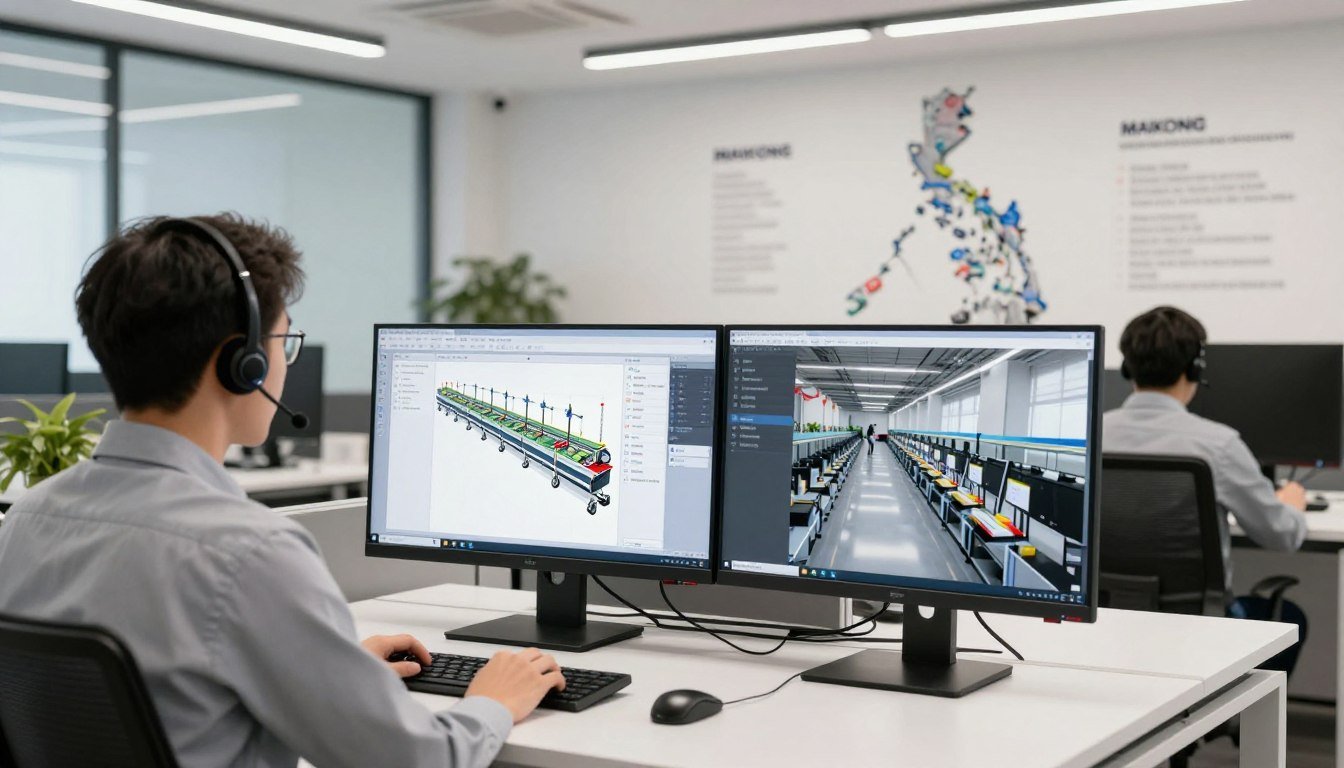
MAIKONG provides free consultation and customized quotations for all inquiries. Share your requirements and receive detailed proposal within 24-48 hours including:
- Equipment configuration recommendations based on your capacity needs, raw materials, and target animals
- Complete technical specifications and performance parameters
- Detailed pricing (equipment, shipping, installation)
- Project timeline from order to commissioning
- Layout drawings showing space requirements
- Electrical load calculations and power requirements
- Operating cost estimates and ROI projections
- Financing options and payment terms
- References from similar projects in Philippines or your region
Contact Methods
Email: Lucy@pelletmachine.ph
Website: https://pelletmachine.ph/
Business Hours: Monday-Saturday, 8:00 AM – 8:00 PM Philippine Time
WhatsApp inquiries answered 7 days/week
Request Detailed Quotation
Why Choose MAIKONG for Your Animal Feed Production Line?
- 22+ Years Manufacturing Experience: Established 2002, over 500 complete production lines delivered worldwide
- Philippine Market Expertise: Systems customized for Philippine voltage (220V/380V), tropical climate, local raw materials (rice bran, copra, corn, fishmeal)
- Complete Solutions: Turnkey projects from design through installation, training, and ongoing support
- Quality Components: Siemens motors, SKF bearings, stainless steel construction, precision-engineered dies
- Proven Performance: Installations across Philippines, Malaysia, Vietnam, Indonesia, Thailand, and 130+ countries
- OEM/ODM Capable: Custom equipment manufacturing for dealers and distributors
- Comprehensive Support: Remote troubleshooting, spare parts availability, technician dispatch, lifetime technical assistance
- Dealer Program: Exclusive territory opportunities for qualified distributors
- Financing Assistance: Help connecting with Philippine banks and agricultural credit programs
- Customer Success Focus: We succeed when your feed business succeeds – committed to your profitability and growth